LIMS vs ELN: Which One Does an Engineering Test Lab Need?

Search “LIMS vs ELN” and nearly every answer is written for a biotech. The pattern is a discovery team running experiments in an ELN, a QC lab running assays in a LIMS, and a recommendation to buy both, often from the vendor who wrote the article. That’s a reasonable answer for drug discovery. It’s the wrong place to start for an in-house engineering or materials test lab at a manufacturer, where most of the work is testing parts and materials for someone else, against a standard, again and again.
A LIMS (laboratory information management system) manages the work a lab does on samples: the requests, the samples, the tests, the results, and the reports, in a structure that’s the same every time. An ELN (electronic lab notebook) records the work a scientist does to find something out: the plan, the procedure as it actually happened, the observations, and the reasoning, in whatever shape the experiment takes.
Put simply, a LIMS is organized around the sample and an ELN is organized around the experiment. This guide covers the difference, where the two overlap, and how to tell which one your lab needs.
The short answer for test labs
Most in-house test labs need a LIMS and don’t need an ELN. Their work arrives as requests from engineers. The methods are written down in advance: an ASTM or ISO standard, a customer specification, an internal procedure. The output is a result against a limit and a report. That’s the shape a LIMS is built for.
An ELN starts to earn its place when the lab also does open-ended research: developing a new material or coating, a design of experiments that runs for months, failure investigations that don’t follow a script. Even then, the research group is usually better served by its own ELN, sending samples to the test lab, than by one system bent to do both jobs.
What a LIMS does
A LIMS is built around the sample and the request. In a test lab that means:
- Test requests come in from requesters with the information the lab needs to start, and the lab works them as jobs with a status everyone can see.
- Samples are received, labeled, tracked between tests, and disposed of, each with its own history.
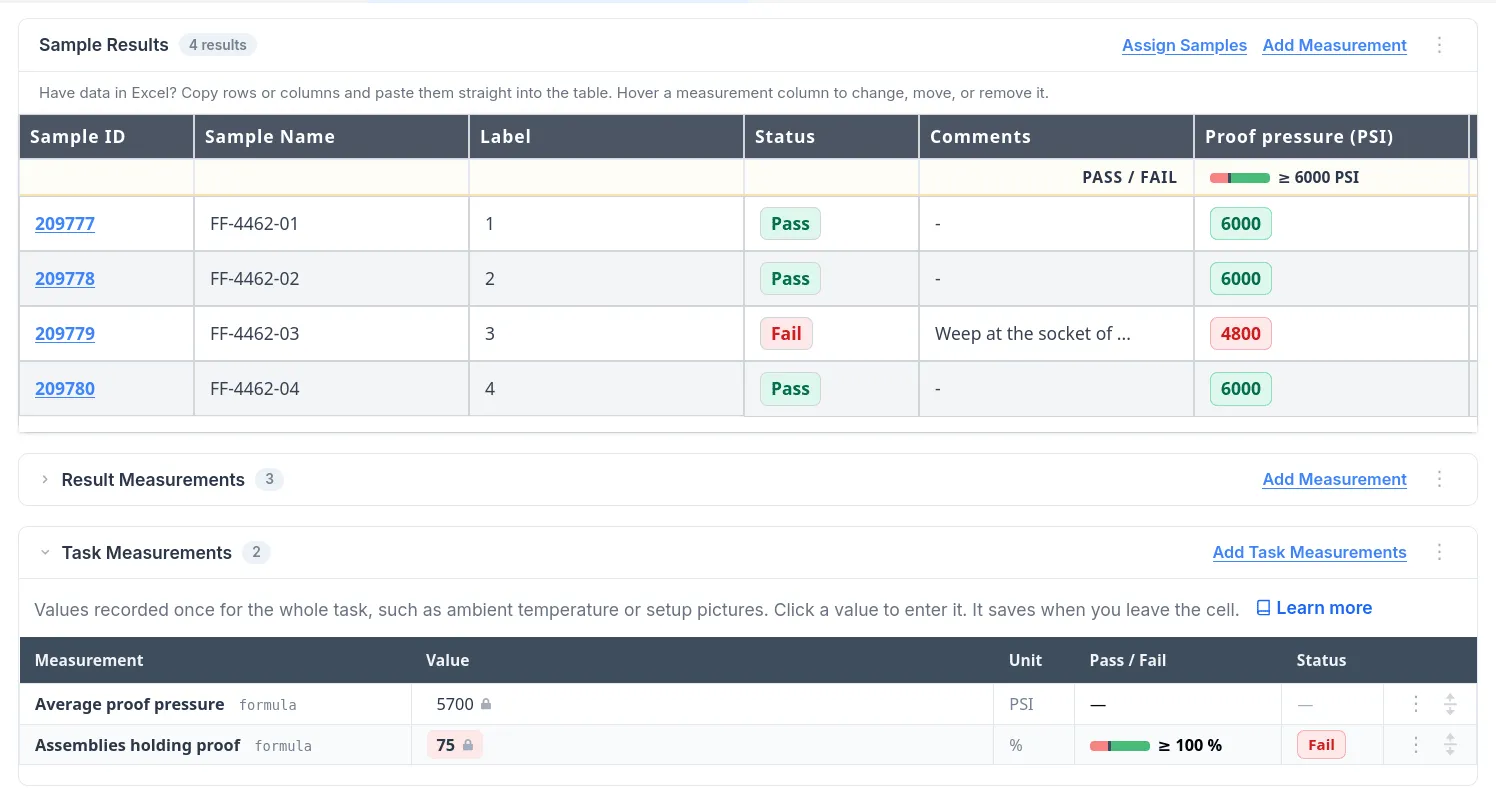
- Tests are defined once, with their method, conditions, measurements, and pass/fail limits, and then run the same way every time.
- Results are recorded against each sample and judged against the limits as they’re entered.
- Equipment used on a test is logged, along with the calibration it was under.
- Reports are generated from the record, not written by hand.
- Every change is recorded: who entered or changed what, when, and why.
The defining feature is structure decided before the work starts. When a tensile test is set up in a LIMS, the measurements, units, and limits exist before the first coupon is pulled, so every result lands in the same column and every report reads the same way. That’s what makes the data searchable across years and comparable across jobs.
What an ELN does
An electronic lab notebook replaces the bound paper notebook a scientist keeps at the bench. It’s built around the experiment and the person running it:
- Entries are written as the work happens: the aim, the setup, what was done, what was seen, and what it means.
- Structure is optional. Templates help, but an entry can hold text, tables, images, sketches, and attached files in any order.
- Protocols are written, copied, and modified from one experiment to the next.
- Projects and people organize the work, rather than samples and requests.
- Signing and witnessing record who did the work and when. That matters for intellectual property, where dated, signed records are evidence of who conceived what, and when.
- Search across everyone’s entries replaces flipping through shelves of notebooks.
In regulated life-science work, ELNs also carry the electronic-records controls of FDA 21 CFR Part 11, such as audit trails and electronic signatures. Benchling, SciNote, and LabArchives are names you’ll see, and most ELN vendors sell primarily to biotech, pharma, chemistry, and academic research.
The defining feature is flexibility. An ELN assumes you don’t know in advance what you’ll record, because the point of the experiment is to find out.
LIMS vs ELN at a glance
| LIMS | ELN | |
|---|---|---|
| Organized around | Samples, requests, and tests | Experiments, projects, and people |
| Typical user | A lab team testing for requesters | A scientist or engineer doing research |
| Structure | Defined before the work: fields, units, limits | Mostly free-form, with optional templates |
| A typical record | Burst pressure for unit 4 against a 3,000 PSI minimum | “Tried a 2-hour cure at 120 °C; adhesion improved, see photos” |
| What “done” means | Every test has results and a sign-off, and the report is out | The experiment reached a conclusion, or the next question |
| Best at | Repeatability, status, turnaround, reporting, traceability | Capturing reasoning, protocols in flux, invention records |
| Weak at | Exploratory work that changes daily | Sample tracking, scheduling, pass/fail, lab-wide status |
| Who asks for it | Lab managers, quality, and the requesters waiting on results | R&D leads, IP counsel, and the scientists themselves |
ELN vs LIMS in one line: an ELN answers “what did we learn?” and a LIMS answers “where is it, and did it pass?”
Why the usual answer doesn’t fit a test lab
The standard advice is ELN for R&D, LIMS for QC, and most labs need both. It comes from life sciences, where one organization has a discovery group writing experiments and a QC group running release assays. In-house test labs at manufacturers look different:
- The requester designs the question, not the lab. An engineer asks whether the new bracket survives 100,000 cycles at 1.5 times rated load. The lab’s job is to answer correctly, on time, with evidence. That’s a request, not a notebook entry.
- The methods are written down before the work starts. A standard, a customer specification, or an internal procedure defines the test. The lab records how it ran the test against that method, not a new protocol each time.
- The same tests run every week. Tensile, hardness, burst, salt spray, thermal cycling, vibration. Repetition is what makes structure pay off.
- Status matters as much as results. A large share of the questions a test lab gets are some version of “where’s my test?” An ELN has no concept of a request waiting in a queue.
That doesn’t mean a test lab has nothing notebook-like to record. It does. It just belongs on the test.
The notebook parts a test lab needs, and where they live in a LIMS
The things engineers reach for a notebook to capture show up in test-lab work too: how the fixture was set up, what the technician noticed, a photo of how the part failed, the back-and-forth about an odd result. A LIMS that only stores numbers leaves those in notebooks, email, and shared drives. In LIMSey they’re part of the job:
- The method write-up. A task’s Details are labeled sections of rich text and pictures: the method, the setup, photos of the fixture, acceptance criteria. Each section has a switch to print it in the report, so the same write-up doubles as the method description in the results.
- The conditions. Parameters record what the test ran at, such as cycles, temperature, pressure, or duration, and result formulas can calculate from them.
- Observations on each sample. Every result row has a comments column that prints beside the result, and a measurement can be rich text or an attachment, for a failure description or a photo taken on a phone at the test stand.
- Things recorded once per test. Task measurements hold values like the ambient temperature, the chamber used, or setup photos.
- The conversation. A job’s Discussions are titled threads with rich text, images, files, replies, and mentions, so the explanation of a strange result stays with the job instead of in someone’s inbox.
- The procedure itself. The Documents library holds controlled procedures and specifications with lettered revisions, and a test links to the revision it followed.
- Who did what, and when. Every change to a job is in its activity history, sign-offs are recorded on the task with the approver and the date, and where an account requires it, changing a saved value asks for a reason.
- Free-form notes, when you want them. Notebook pages, one per person or per project, are an option that can be turned on for labs that want a place for open-ended notes alongside the structured record.
If most of the work itself is open-ended research rather than requested testing, though, that’s the signal for an ELN, covered below.
ISO 17025 calls it a technical record
If your lab is accredited, the standard already says what the “notebook” has to contain. Clause 7.5 of ISO/IEC 17025:2017 asks that technical records:
- hold the results, the report, and enough information to identify what affected the result and to repeat the test under conditions as close as possible to the original;
- record the date and the person responsible for each activity, and for checking the data and results;
- capture original observations, data, and calculations at the time they’re made, identifiable to the specific task;
- when something is amended, keep both the original and the amended data, with the date, what changed, and who changed it.
That’s a description of a LIMS record more than a notebook entry. The test, its conditions, the equipment and its calibration, the raw results, the people, the sign-off, and the change history all sit on the same job. A paper or electronic notebook can meet the clause too, but only if every entry ties back to the sample, the job, and the report. Making that link by hand is the part that takes a person, and it’s the part an assessor will sample.

More on how LIMSey maps to the standard is on our ISO 17025 page, and our post on LIMS data security covers audit trails in more depth.
When an engineering lab does need an ELN
An ELN is worth buying when the work is genuinely exploratory and someone needs the reasoning on record:
- A materials or product development group working out a new alloy, coating, adhesive, or formulation, where each run changes based on the last.
- Long design-of-experiments studies where the plan, the factor settings, and the analysis need to live together.
- Invention records, where IP counsel wants dated, signed entries showing who did what.
- Regulated research in pharma, medical devices, or biotech, where 21 CFR Part 11 notebook records are expected.
- Academic and government research labs, where the notebook is the record of the research itself.
If none of those describe your lab, an ELN is likely to become a second place to type the same results.
When you need both, draw the line at the sample
Plenty of manufacturers have both: an R&D group in an ELN and a test lab in a LIMS. The setups that work draw the boundary at the sample:
- The ELN owns the experiment: the hypothesis, the design, the formulation, the analysis, and the conclusions.
- The LIMS owns the testing: the request, the samples, the methods, the equipment, the results, and the report.
- The hand-off is a test request. The R&D engineer submits samples to the lab like any other requester, and the job number goes into the notebook entry. Results come back as a report, or through an API into the notebook.
That keeps one source for each fact. The research group doesn’t run its own shadow sample tracking, and the lab doesn’t have to read anyone’s notebook to know what to test.
In LIMSey, R&D engineers who submit requests, track status, and receive reports use the lower-cost requester seat, and other systems read jobs and results through a REST API with scoped tokens (see integrations). That API is how LIMSey connects to an ELN; tell us which one you use.
Single platforms that combine an ELN and a LIMS exist, mostly from enterprise vendors selling to life sciences. STARLIMS, for example, sells an integrated platform of LIMS, ELN, and scientific data management. They make sense when one organization has large research and QC groups working on shared data. For a test lab of five to thirty people, they usually mean paying for, and implementing, the half you won’t use.
Signs you’re using one as the other
An ELN being used as a LIMS:
- Finding a sample’s results means searching entries by part number.
- Nobody can say how many tests are waiting, or whose they are.
- Pass or fail is decided by whoever reads the entry.
- Reports are copied out of notebook pages into Word.
- The same test is written up differently by every technician.
A LIMS being used as an ELN:
- A new template gets built for every one-off investigation.
- The comments field holds two pages of reasoning.
- Researchers keep a notebook anyway, and the LIMS gets a summary later.
In many engineering labs, the “ELN” isn’t an ELN at all. It’s a shared drive, a OneNote or SharePoint page, and a spreadsheet per technician. That isn’t a notebook problem. It’s a missing LIMS, and our comparison of LIMSey and spreadsheets covers when it’s time to move.
Questions to ask before buying either
- Is most of our work requested by someone else, or designed by us? Requested work points to a LIMS.
- Do the same tests repeat? If they do, structure pays for itself.
- Who asks “where is it?” every day, and where do they look now?
- Do we need records for accreditation, for IP, or both? ISO 17025 points to a LIMS; invention records point to an ELN.
- Where does a sample’s history live today? If the answer is “in several people’s notes,” start there.
- What would we stop using? A new system that doesn’t retire a spreadsheet, a notebook, or a shared drive becomes one more place to look.
If the answers point to a LIMS, our guide to choosing a LIMS walks through requirements, demos, and red flags, and our comparison of LIMS for engineering and materials test labs covers who fits this kind of lab.
FAQ
What is the difference between a LIMS and an ELN? A LIMS manages the lab’s work on samples (requests, samples, tests, results, and reports) in a fixed structure. An ELN records a scientist’s experiments (plans, procedures, observations, and reasoning) in a flexible format. A LIMS is organized around the sample; an ELN is organized around the experiment.
Do I need both a LIMS and an ELN? Only if you have both kinds of work. Labs that mostly test parts and materials for requesters need a LIMS. Labs that mostly run open-ended research need an ELN. Organizations with a research group and a test lab often use both, with the test request as the hand-off between them.
Can a LIMS replace an ELN? For a test lab, usually yes, as long as the LIMS holds more than numbers: method write-ups with pictures, observations and photos on results, discussion threads on each job, and a full change history. For a research group whose experiments change daily, no. A LIMS’s structure gets in the way.
Can an ELN replace a LIMS? Rarely. ELNs don’t track samples through receipt, storage, and disposal, don’t judge results against limits, don’t show the status of a queue of requests, and don’t generate standard test reports. Labs that try it usually end up rebuilding those pieces in spreadsheets.
What’s the difference between a LIMS, an ELN, and an SDMS? A LIMS manages samples, tests, and results. An ELN records experiments. An SDMS (scientific data management system) stores and catalogs the raw data files instruments produce. Many test labs don’t need a separate SDMS, because the LIMS keeps the result and can keep the instrument’s export file attached to it; our guide to LIMS instrument integration covers how.
Does LIMSey include an electronic lab notebook? LIMSey is a LIMS built for in-house engineering and materials test labs at manufacturers, not an ELN. It covers the notebook-like parts of test-lab work: rich-text method write-ups with photos, result comments and attachments, discussions on each job, controlled documents, and a complete change history. Free-form notebook pages, one per person or per project, are an option that can be turned on for labs that want them. Labs whose main work is open-ended research usually keep it in an ELN and send samples to the test lab as requests.
Is an ELN required for ISO 17025? No. ISO/IEC 17025 requires technical records with enough information to repeat a test, the people and dates involved, original observations recorded at the time, and a history of amendments. A LIMS that records those against each job meets the requirement, and so can a notebook, if every entry ties back to the sample and the report.
If you’d like to see how a test lab’s requests, samples, results, and records fit together, book a demo.